|
27 October 2025
ICID Events
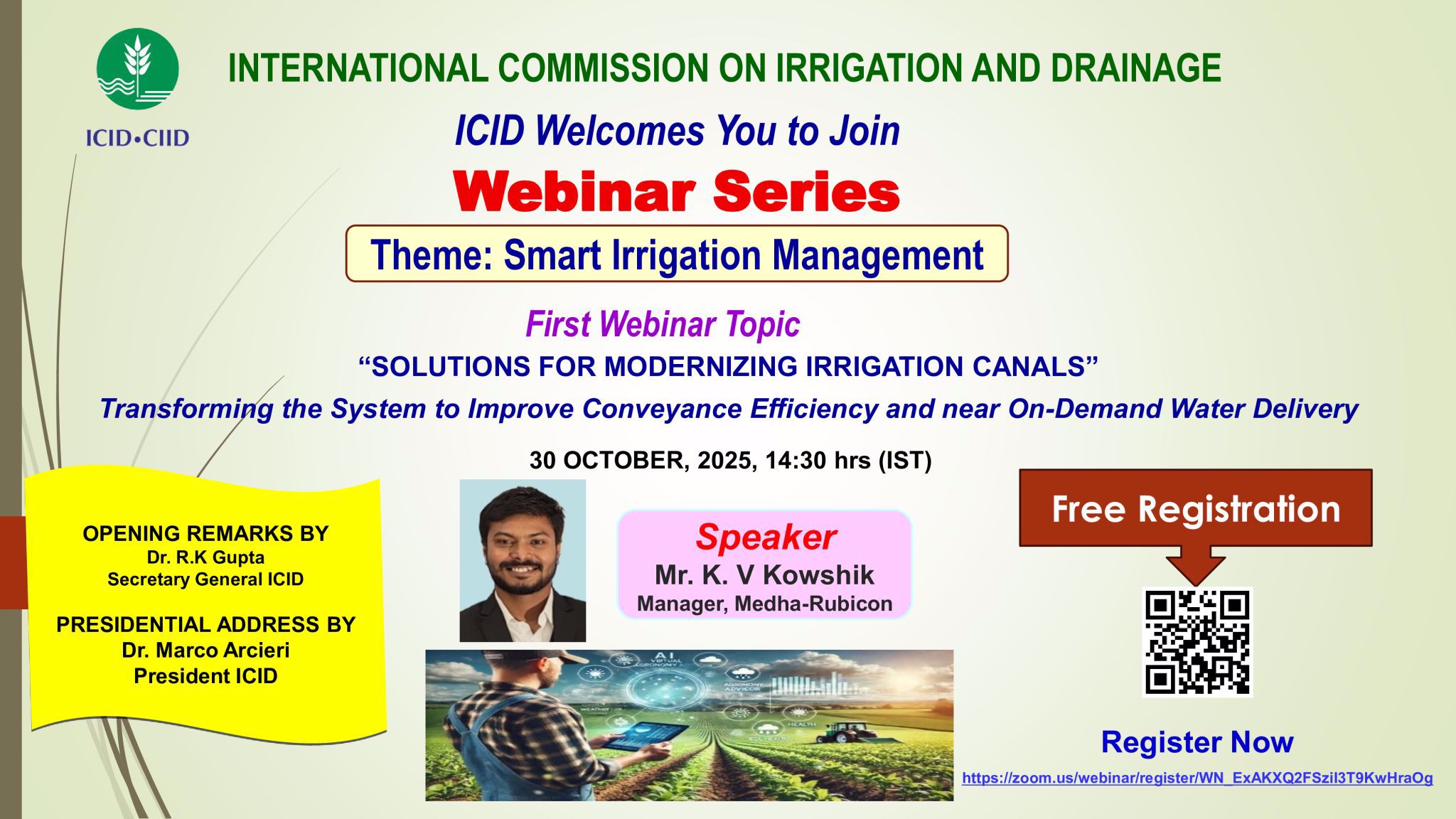
ICID is starting a “Technical Webinar Series” on the theme "Smart Irrigation Management" showcasing best practices and success stories in agricultural water management. The first webinar of this series is on the topic “
Solutions for Modernizing Irrigation Canals: Transforming the system to improve conveyance efficiency and near on-demand water delivery”
will be held on October 30, 2025 at 14:30 hrs (IST). For more details please visit the link: https://icid-ciid.org/inner_page/271
77th IEC Meeting & 26th ICID Congress, Marseille, France, 12-18 October 2026
Theme: “Agriculture and climate change: stakes and levers for irrigation and drainage.”
78th IEC Meeting & 5th World Irrigation Forum (WIF5), at Guoce International Conference & Exhibition Center, Beijing, China, 2027
Other Events
XIX World Water Congress, on theme WATER IN A CHANGING WORLD: INNOVATION AND ADAPTATION, Marrakech, Morocco, 1 - 5, December 2025. https://worldwatercongress.com/
ASABE Global Symposium on Sustainable Microirrigation Advances: Drop to Boom, Aguadilla, Puerto Rico, USA, 11-17, January 2026
Theme - Less is better than more to provide water & food security to people: Drop to boom
Invitation to Join ICID Membership
The Commission thrives on its worldwide network of experts from multifarious disciplines from 70 countries, who came together in the interest of global water management. All are members contribute to this higher cause by offering their voluntary services.
Currently, there are two different kinds of membership categories; National Committees and Direct Members. National Committees (NC) represent their countries mostly through their government departments responsible for irrigation, drainage or agricultural water management.
Companies, institutions, and individuals can also participate in ICID activities through their respective NCs or as Direct Members (DM). Professionals, individuals and officers of a government or of an institution or institutions - government and non-government; and companies, effectively representing interests within the scope of the objects of the Commission can participate in ICID activities through Direct Membership, to further the objects of the Commission in their countries or sovereign areas.
In the course of our activities and events conducted throughout the world, we associate with many different kinds of NGOs, national governments, researchers, corporate sectors, civil society organizations, and individuals. They are not necessarily members of ICID network but our associates and an important part of ICID fraternity. For more details, please visit: https://icid-ciid.org/view_page/2
. 
World's penguins under pressure from cumulative climate impacts
24 October 2025
For the world's population of penguins, survival may now depend on a new way of understanding climate change, as scientists suggest examining the cumulative impact of marine heatwaves, storms, or heat surges instead of addressing them in isolation.
Multi-century global and regional sea-level rise commitments from cumulative greenhouse gas emissions in the coming decades
24 October 2025
Sea levels respond to climate change on timescales from decades to millennia. To isolate the sea-level contribution of historical and near-term GHG emissions, we use a dedicated scenario and modelling framework to quantify global and regional sea-level rise commitments of twenty-first century cumulative emissions.
Critical intervention points for European adaptation to cascading climate change impacts
16 October 2025
Here we analyse cascading climate change impacts on the EU, originating from outside the region, and identify critical intervention points for adaptation. Using network analysis, we integrate stakeholder-co-produced impact chains with quantitative data for 102 countries across foreign policy, human security, trade and finance.
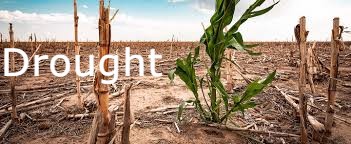
Could climate change create a new dust bowl?
24 October 2025
Researchers at UC Santa Cruz contributed to a new global study published in Science that reveals how severe, long-term drought affects crucial grassland and shrubland ecosystems around the world.
Mosquitoes spotted in Iceland for the first time after record-breaking heatwave
22 October 2025
Iceland’s typically cold climate and scarcity of stagnant water have long prevented mosquitoes from surviving there, making it one of only two mosquito-free zones in the world — the other being Antarctica.
Prolonged drought causes unprecedented productivity loss: Study
21 October 2025
“Climate change is bringing more severe and longer-lasting droughts to many locations around the world. Some ecosystems have shown resilience to increasing drought, but this could change as droughts become more severe,” said the study.
Multi-century global and regional sea-level rise commitments from cumulative greenhouse gas emissions in the coming decades
24 October 2025
Sea levels respond to climate change on timescales from decades to millennia. To isolate the sea-level contribution of historical and near-term GHG emissions, we use a dedicated scenario and modelling framework to quantify global and regional sea-level rise commitments of twenty-first century cumulative emissions.
What local leaders can teach us about floods
23 October 2025
Flooding remains one of the most prevalent natural hazards worldwide, affecting millions of lives annually. All over the world, we are witnessing how floods are a continuous threat, destroying homes, damaging infrastructure, and disrupting lives at local and regional levels, with impacts rippling out to national and global scales.
Hand in Hand for Better Foods and a Better Future? Taking Stock of Global Food Security after the 2025 World Food Forum
24 October 2025
In mid-October, over 16,000 participants gathered in Rome for the World Food Forum, an annual flagship event facilitated by the Food and Agriculture Organization of the United Nations (FAO) to connect government leaders, multilateral organisations, youth organisers, and food systems innovators.
Ghana Marks World Food Day 2025: Hand in Hand for Better Food and a Better Future
21 October 2025
The 2025 World Food Day celebration in Ghana reaffirmed the country’s commitment to achieving food and nutrition security while highlighting the enduring partnerships that drive progress toward Zero Hunger (SDG 2).
Why Food Resilience and Security Must Be a Cornerstone at COP30
20 October 2025
Food resilience and equitable climate action are interconnected, both aim for just and regenerative food systems that benefit both people and the planet. This cannot fall off the political agenda as the world approaches COP30.
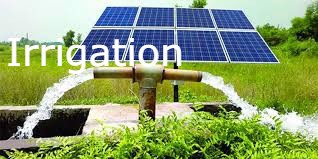
How smarter irrigation is changing Nigerian farming
15 October 2025
The project’s impact extended beyond the fields. Irrigation canals were cleared, access roads repaired, and communities were introduced to better water management practices.
Downscaled global 60-meter resolution estimates of irrigation water sources (2000–2015)
9 October 2025
This dataset provides high-resolution (60 m) global irrigation maps to support water resource and agricultural management. It identifies the likely irrigation status (rainfed or irrigated) and water source (groundwater or surface water) of croplands for 2000, 2005, 2010, and 2015.
Can Japan Lead the World in Water Drone Technology?
27 October 2025
The partners aim to leverage the nation's advanced shipbuilding technology to deploy mass-produced water drones for combating illegal fishing, advancing marine development, and enhancing national security.
How Finland’s tap water is cleaner than most bottled water and what we can learn from it
25 October 2025
Finland's tap water is a marvel, with 99.98% meeting stringent health standards. This exceptional quality stems from pristine natural sources and robust treatment systems.

Road Map to ICID Vision 2030- and Three-Year Rolling Plan
The water crisis, one of the most complex challenges of the 21st century, stems from a multitude of factors such as climate change, rapid population growth, inefficient consumption patterns, increasing demand, and mounting pressure on limited water resources. These issues have made a fundamental revision of water management and governance approaches inevitable. Global estimates indicate that by 2050, over two-thirds of the world's population will face water stress. https://icid-ciid.org/icid_data_web/RoadMaptoVision20230-2025.pdf
Guidelines for Irrigation with Reclaimed Water
Using wastewater or poor-quality water for irrigation is one of the eight technical strategies proposed in the roadmap to 2030 ICID Vision “A water-secure world free of poverty and hunger through sustainable rural development”. Reclaimed water is considered a stable alternative water source for irrigation which is increasingly used worldwide.
https://icid-ciid.org/icid_data_web/GuidelinesforReclaimedWater2025.pdf
Environmental Drainage
This book begins by discussing general environmental issues. It then delves into the pollutants found in drainage water, with a particular focus on soil and water salinity, especially in arid and semi-arid regions. The residues of chemical fertilizers and animal manure, particularly nitrogen and phosphorus, are major environmental pollutants.
https://icid-ciid.org/icid_data_web/EnvironmentalDrainage2025.pdf
Guide to Innovated Irrigation and Drainage Management under the Changing Climate
Agriculture is a significant global user of freshwater resources, accounting for 70% of usage and contributing up to 30% of greenhouse gas emissions. Therefore, it is both a contributor to and a victim of climate change. The Working Group on Climate is dedicated to addressing the mitigation and adaptation challenges faced by agricultural water management in the context of a changing climate. https://icid-ciid.org/icid_data_web/ClimateChangeGuideBook2025.pdf
The United Nations World Water Development Report 2025, Mountains and glaciers: water towers - The United Nations World Water Development Report 2025 – Mountains and glaciers: Water towers calls attention to the essential services and benefits mountain waters and alpine glaciers provide to societies, economies and the environment. With a focus on the technical and policy responses required to improve water management in mountains, the report covers critical issues such as water supply and sanitation, climate change mitigation and adaptation, food and energy security, industry, disaster risk reduction and ecosystem protection. https://unesdoc.unesco.org/ark:/48223/pf0000393070
ICID Publication - Historical Water Sustainability, 2023
The latest data from WRI’s Aqueduct Water Risk Atlas (August 2023) show that 25 countries housing one-quarter of the global population face extremely high water stress each year, regularly using up almost their entire available water supply. And at least 50% of the world’s population around 4 billion people live under highly water-stressed conditions for at least one month of the year. https://icid-ciid.org/icid_data_web/HWS-ePublication.pdf
ICID Publication - Compendium World Heritage Irrigation Structures (2014-2022)
Since the dawn of human civilization water has been an enabler of societal development so much so that we started believing “Water is Life,” a common phrase in most languages. And, life is multi-dimensional involving not only a physical aspect but also economic, social, cultural, political, religious, and spiritual concepts.
https://icid-ciid.org/icid_data_web/WHISCompendium-ePublication.pdf
ICID Publication - Water-Saving in Agriculture - A Roadmap to ICID Vision 2030
This publication is in a way to celebrate the 7-decade existence and relevance of ICID which started with a handful of members and has grown to represent more than 90% of the world irrigated area.
https://www.icid-ciid.org/icid_data_web/Watsave_eBook2022_comp.pdf
|
|
|---|
|
IRRIGATION AND DRAINAGE - THE JOURNAL OF ICID
Articles available via complimentary online access @ https://wileyonlinelibrary.com/journal/ird
ICID e-Bulletin is a weekly compilation of news items on ICID-related issues in the domain of Agriculture, Climate Change, Droughts, Floods, Food Security, Irrigation, and Water Resources Management that might be of interest to the ICID fraternity. The information contained in the BULLETIN does not purport to be exhaustive and is taken ''as it is'' from external sources and is freely available on the internet. No evaluation on the part of the ICID Central Office is being made in terms of the authenticity of the information that it may contain. ICID Central Office makes no guarantee, either express or implied, as to the accuracy of the information published. Your valuable feedback on the usefulness of the bulletin is solicited at <icid@icid.org.>.
[ Compiled and Edited by: Er. Vijai Saran, Director, ICID and Mr. Anurag Mamgain ]
**SAVE PAPER, SAVE TREES..!! Please do not print this e-mail unless necessary**
|
|
|---|
|
|
INTERNATIONAL COMMISSION ON IRRIGATION AND DRAINAGE (ICID)
48 Nyaya Marg, Chanakyapuri, New Delhi - 110021, India
Tel : +91-11-26116837, +91-11-26115679
|
|
|---|
|
|
|
| |
|  |
|
|
|
|